
The Ministry of Education and Health presented the protocol Recommendations for Action for Carrying Out In-Person Activities in Higher Education Institutions in the Context of COVID-19, a document that provides guidance within the framework of the modifications applied to the Step-by-Step Plan.
Regarding the mobility of students and workers from higher education institutions, it should be noted that, as of Phase 2, higher education institutions do not require unique collective permits for the attendance of their staff and academics. This will only be necessary for personnel residing in communes that are in Phase 1. In the case of students, those residing in communes under quarantine will be able to travel and attend their educational institutions, provided they have a mobility pass enabled and their institutions are located in communes that are in Phase 2 or higher.
In addition to promoting self-care measures among students, faculty, and higher education workers, the protocol details measures for carrying out in-person activities and workshops:
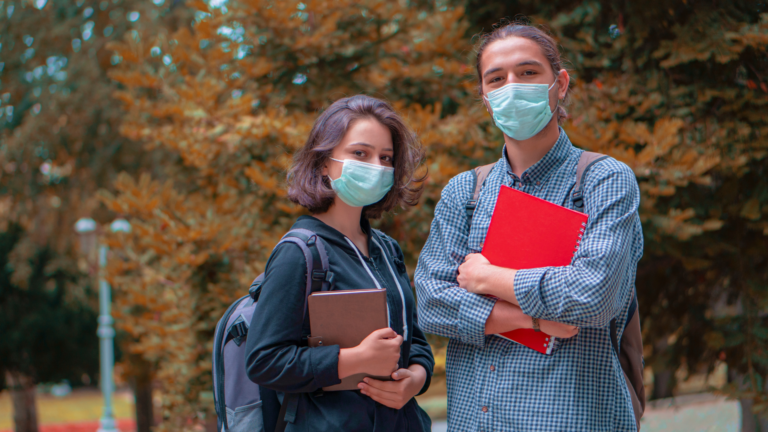
- Mandatory and proper use of masks, covering both the nose and mouth, by all students, teachers, and general staff participating in the activity.
- Maintain adequate and continuous ventilation of enclosed spaces (also applies to casinos, cafes, libraries, study rooms, offices, etc.).
- Maintain a minimum physical distance of 1 linear meter between people, along with adequate ventilation of spaces. In the case of workshops, laboratories, classrooms, or other facilities where it is not possible to permanently maintain physical distancing, special attention must be paid to adequate ventilation of the facilities, in addition to the correct use of masks.
- For activities in clinical settings, the measures available in the Recommendations for Action for Health Establishments in the context of COVID-19, officially established by Ordinary No. 5308, dated December 11, 2020, must be considered.
- Formative sports activities may be carried out normally outdoors. Other types of sports activities, such as those taking place inside gyms, must be carried out following the guidelines of Exempt Resolution No. 644, dated July 14, 2021, of the Ministry of Health and its modifications.
- Other spaces such as libraries, study rooms, living rooms, and others may be used normally, provided that masks are worn at all times and the spaces are adequately ventilated.
- In the event that a casino or cafeterias are present, they must comply with the provisions of Exempt Resolution No. 644, dated July 14, 2021, of the Ministry of Health and its modifications.
- In all types of in-person activities, a record of attendees must be kept for traceability purposes, if necessary.
To learn all the details of the protocol, visit this Link


 Obtaining academic background: certificates (notes, a regular student, ranking, recognition of hours, title, grade, and exit), plans and programmes, concentration notes
 Problems in the community institutional arising from violations of the internal regulations of the institutions
 Charges for removal or academic suspension, charging wrong.
 Benefits and/or grants student grants and loans)
 Misleading advertising
 Infrastructure or equipment, laboratories, computer support
 Application and admission selection test
 Comprehensive policy against sexual harassment, violence and gender discrimination


