

The Superintendency of Higher Education (SES) released the report on claims and complaints filed through its citizen service platform against higher education institutions during 2024, noting a% increase compared to last year, with a total of 5.383 Requirements.
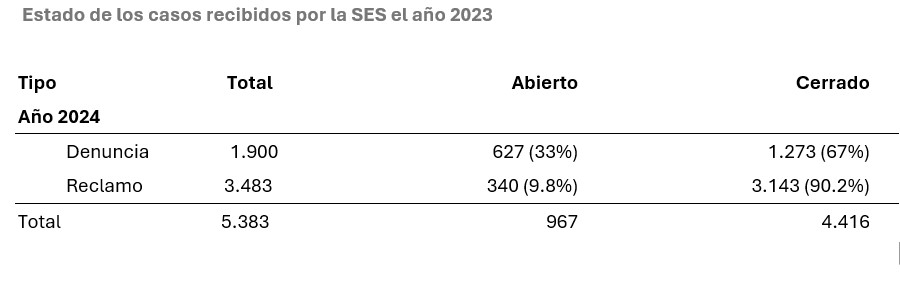
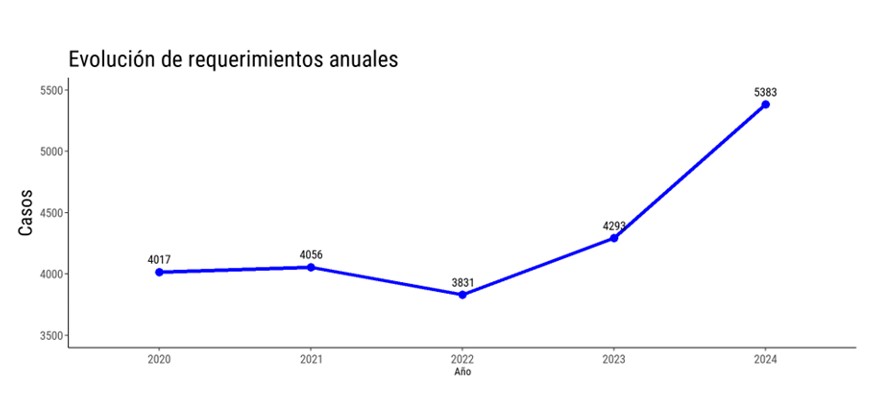

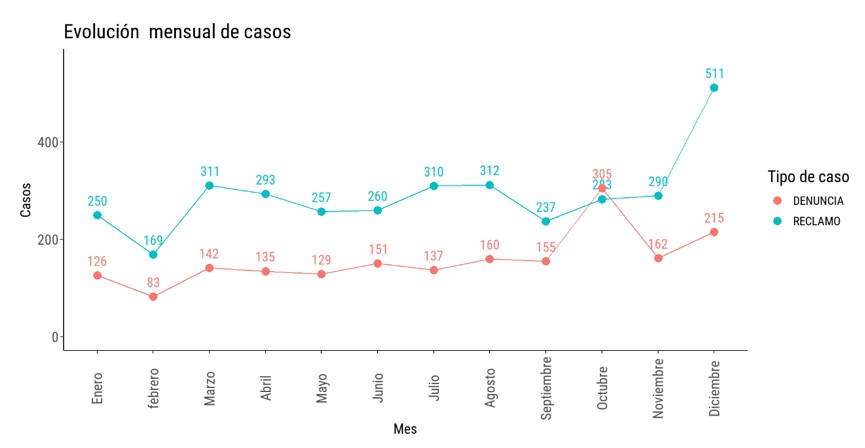
Regarding this point, the Superintendent of Higher Education, José Miguel Salazar He pointed out that: “We believe that this increase in the registration of claims and complaints that occurred during 2024 is largely due to the fact that during last year several institutions faced significant financial problems and also in terms of coexistence, situations that required various oversight actions by the Superintendency and, along with that, also intense action in terms of addressing the claims and complaints that arose from these communities.”.
Favorable resolutions for the claimant
The report prepared by the SES's Public Information and Studies Unit highlights that the 57,2% of the admissible and closed cases during 2024 ended with a favorable resolution for the applicant, raising the record by one point compared to the previous year (56%). This is because in 957 cases the requested institution committed to a solution and in others 356 cases showed a solution.
Superintendent Salazar expressed his satisfaction with this particular point:
“We value the collaborative attitude that higher education institutions have shown in resolving the concerns of their communities. Their willingness to reach agreements has been fundamental to this outcome, as has the work of our teams, whose mediation skills have made it possible to channel and facilitate the agreements.
The SES citizen care platform is available on the website www.sesuperior.cl y ofrece un servicio 100% remoto, pudiendo los usuarios verificar en línea los pasos que se han ido ejecutando en la tramitación de sus casos. Además, a mediados del año pasado se implementaron dos nuevas plataformas digitales orientadas a reforzar la atención a usuarios: un chat de asistencia en base de inteligencia artificial y una APP, descargable, para el ingreso y seguimiento de reclamos y denuncias para estudiantes.
Distribution evolution by IES type of admissible and closed cases (2020 – 2024)
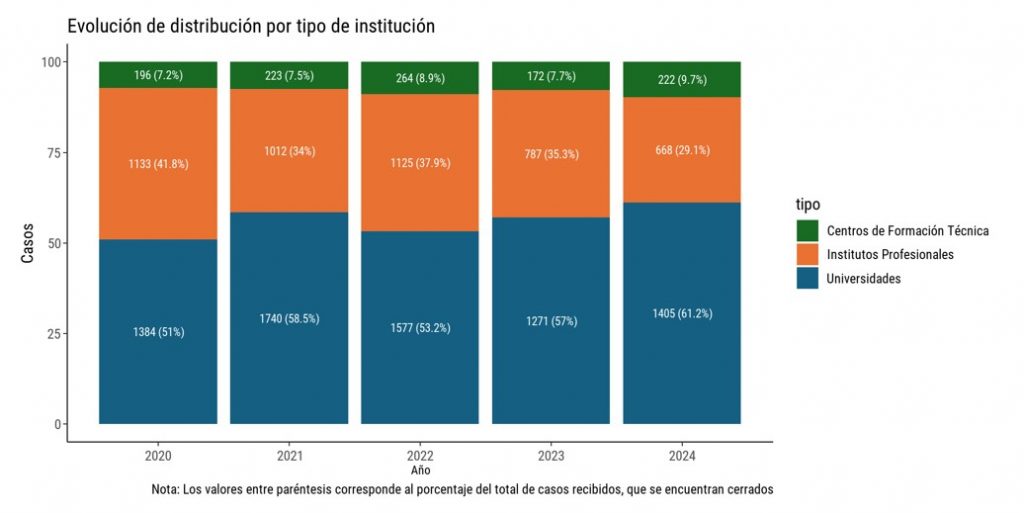
When segregating by type of institution the total claims and complaints that entered the SES in 2024, the result shows that universities, which concentrate 55.5% of the total enrollment in the higher education system, accumulated the 61,2% of the cases, confirming the increase recorded over the past three years. The Professional Institutes (IP), which account for% 34 of the enrollment, received the 29,1% of the requirements; while the Technical Training Centers were the subject of the 9,7% of the claims and complaints, with a registration that represents% of the system.
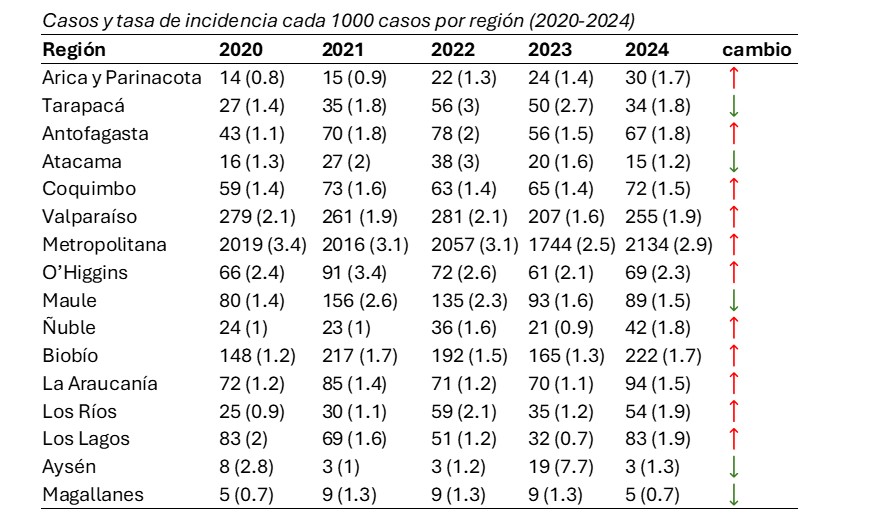
Distribution of cases by region, previous year variation, and rate per thousand enrolled.
In this subject, the Metropolitan Region is the one with the highest complaint rate, with 2.9 filings per thousand students. They are followed by O'Higgins with 2.3, y Valparaíso, The Rivers y The Lakes, all with 1.9.
Most claimed categories
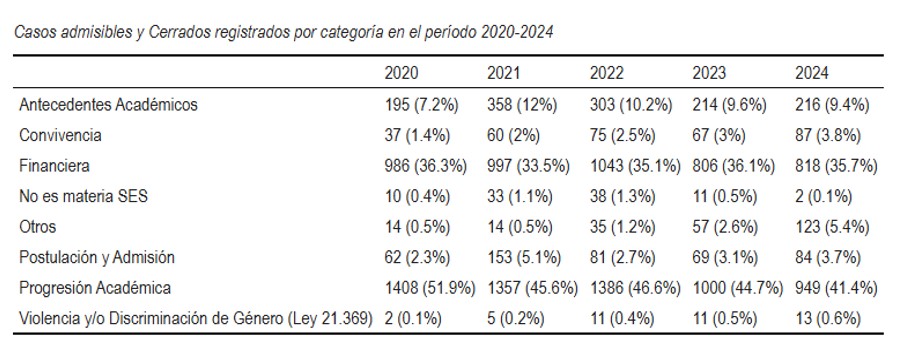
The claim categories were redefined during the year 2024 to better align with the content of the claims entering the system. All obsolete categories were retroactively re-coded, updating them to the new nomenclature.
Regarding the themes that generated the most complaints during 2024, these were concentrated in the categories Academic Progression, with 949 requirements, which represents a 41.4% of the total cases received, and Financial company, with 818 cases, equivalent to a 35.7%.
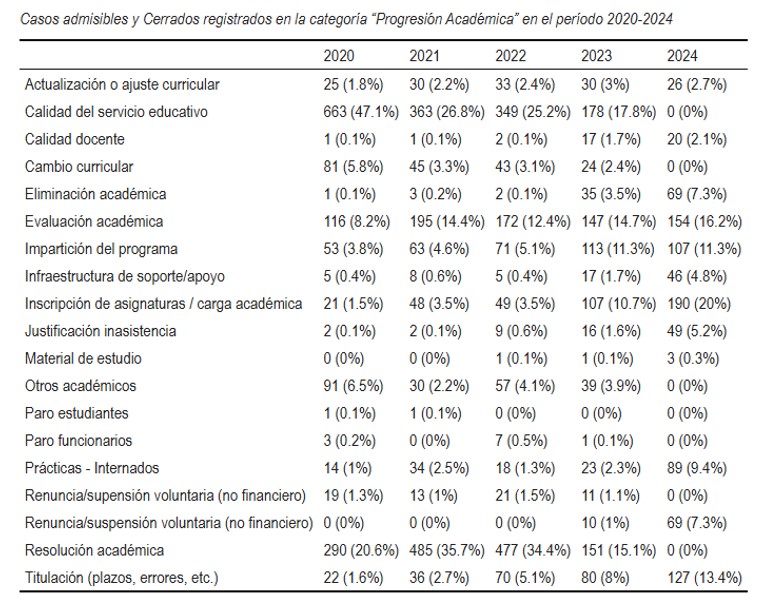
Subjects in Academic Progression Category
Inside the area Progression Academic, the subject that concentrated the most cases was the one associated with problems with the Course Enrollment/ Academic Load, with a total of 190 requirements, equivalent to 20% from that category; followed by Academic Evaluation with 154 cases16,2%); y Internships, with 89 (9.4%).
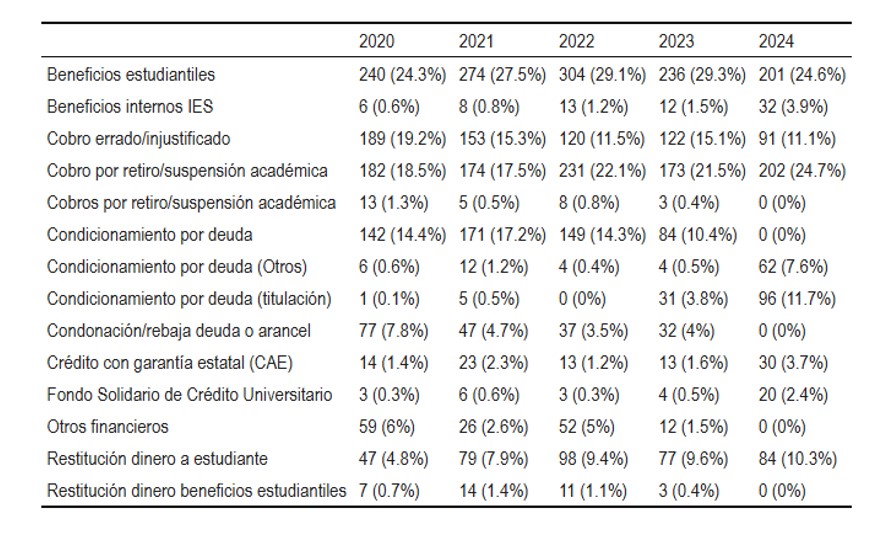
Financial Category Subjects
In the category Financial, the most repeated cases had to do with problems in the area of Fee for academic withdrawal/suspension, with 202 presentations24.7%); Student benefits, 201 (24.6%and Debt conditioning (titling), with 96 (11.7%).
Subjects in Academic Background category
The largest presentations in this category focused on the following subjects: Title certificates, with 122 cases56.5%), Note concentration y Plans and programs, with 25 cases each (11.6%).
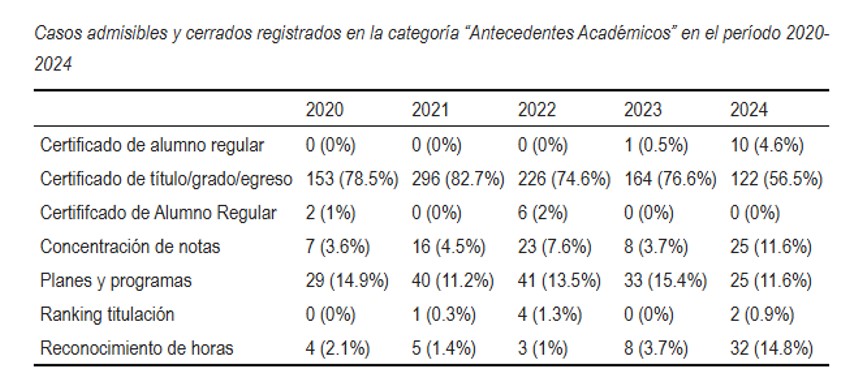
Subjects in the Application and Admission category
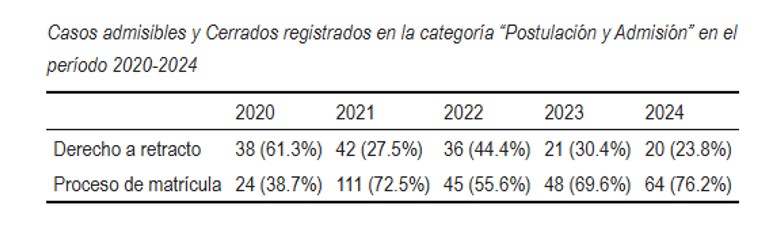
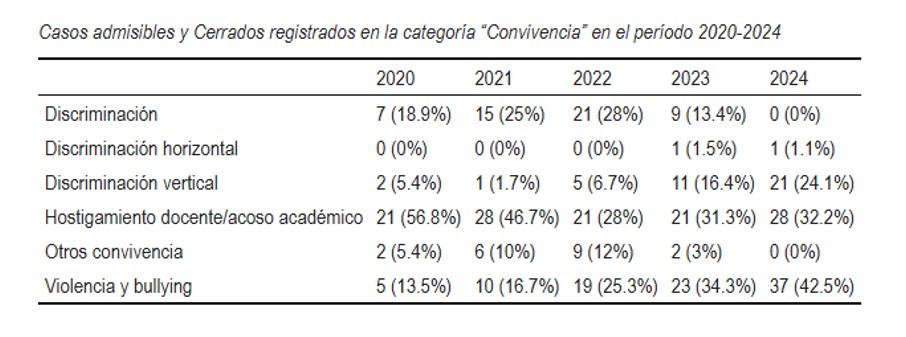
Subjects in Category Coexistence
For reasons of Coexistence received 87 cases3.8% of the total), with the most claimed subjects in this area being those related to Violence and bullying, with 37 cases42.5%); Teacher harassment/academic bullying, with 28 (32.2%and Vertical discrimination, with 21 (24.1%).
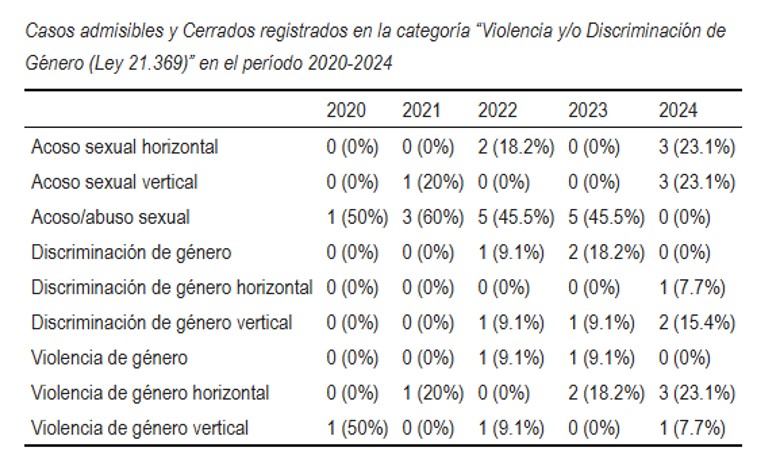
Matters in the category of Gender Violence and/or Discrimination (Law 21.369)
In this category, the most claimed subjects were: Sexual harassment from a superior, Sexual harassment between peers y Horizontal gender-based violence, all of them with 3 cases23.1%)


 Obtaining academic background: certificates (notes, a regular student, ranking, recognition of hours, title, grade, and exit), plans and programmes, concentration notes
 Problems in the community institutional arising from violations of the internal regulations of the institutions
 Charges for removal or academic suspension, charging wrong.
 Benefits and/or grants student grants and loans)
 Misleading advertising
 Infrastructure or equipment, laboratories, computer support
 Application and admission selection test
 Comprehensive policy against sexual harassment, violence and gender discrimination


