

This Sunday marks International Women's Day, a date that invites us to reaffirm commitments. From the Superintendency of Higher Education (SES), we recognize all the women who are part of higher education communities across the country and reiterate our institutional responsibility to safeguard spaces free from sexual harassment, violence, and discrimination, promoting gender equality in each institution.
In the exercise of its functions, the SES monitors and supervises compliance with Law 21,369, which establishes a regulatory framework to prevent, investigate, and sanction sexual harassment, gender-based violence, and discrimination in higher education. Since 2022, we have carried out systematic oversight, verifying the adoption of comprehensive policies, prevention, and investigation models in the institutions and units in charge, noting their general implementation in the system.
In October 2025, during the National Meeting organized by the Gender Equality Commission of the Council of Rectors of Chilean Universities (CRUCH), the SES presented the main results of the oversight actions carried out since the law came into effect. Among the actions, the issuance of legal pronouncements (two circulars and 11 ordinary official letters), the execution of oversight programs, sanctioning procedures, and the processing of complaints and reports from members of educational communities stand out.
Currently, within the framework of the 2026 Annual Auditing and Oversight Plan, the third Auditing Program for Law 21.369 is being formulated, focusing on the effective compliance of implemented policies, in key aspects such as institutional diagnostics, and the adoption of protective measures and victim support.
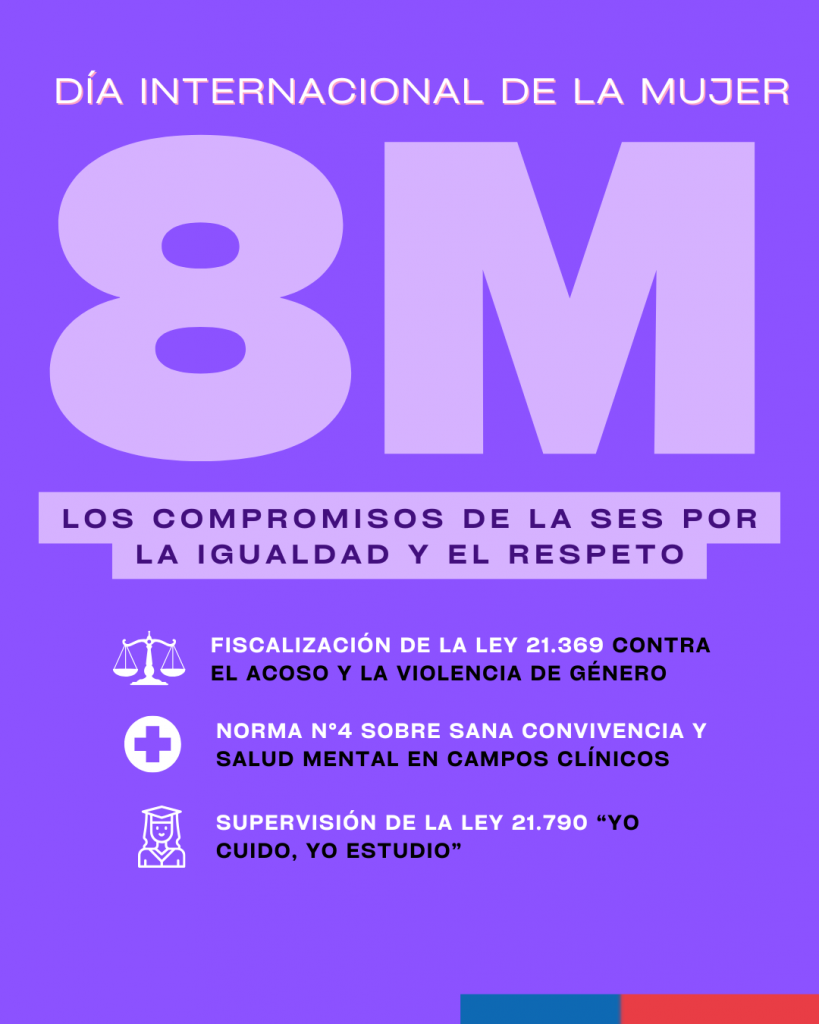
Our commitment to gender equality goes beyond this law. In 2026, General Standard No. 4 on Healthy Coexistence and Protection of Mental Health in Clinical Settings came into effect, which addresses faculty harassment, academic bullying, gender-based violence, coexistence problems in general, and particularly mental health problems derived from these situations among students in higher education health-related programs.
The text incorporates a gender perspective and inclusive language, recognizing the higher incidence of mental health issues in women and the directionality of gender-based violence towards women and diverse groups.
In addition, the entry into force of Law 21.790, “I Care, I Study,” grants the SES the oversight of the adoption of concrete norms and measures by higher education institutions, which protect the rights of students with care responsibilities, promoting co-responsibility, continuity of studies, and the reconciliation between academic and family life for those who care for children or persons with disabilities or dependency.
On this March 8th, we reaffirm our conviction to advance towards higher education without gender gaps, more just, safe, and inclusive for all, as a permanent and priority task.


 Obtaining academic background: certificates (notes, a regular student, ranking, recognition of hours, title, grade, and exit), plans and programmes, concentration notes
 Problems in the community institutional arising from violations of the internal regulations of the institutions
 Charges for removal or academic suspension, charging wrong.
 Benefits and/or grants student grants and loans)
 Misleading advertising
 Infrastructure or equipment, laboratories, computer support
 Application and admission selection test
 Comprehensive policy against sexual harassment, violence and gender discrimination


